How to Tell Fake MTG Cards: 8 Checks as Wizards Sues Counterfeiters
As of November 25, 2026. Wizards of the Coast LLC, the publisher of Magic: The Gathering, filed a civil lawsuit on November 23, 2026 in the federal court for the Western District of Washington in Seattle: case No. 2:26-cv-04617. The named defendants are a Utah resident, the people and companies listed in an appendix to the complaint, and 15 unidentified individuals, together called the "PrintMTG Enterprise". Wizards alleges the group ran a network of websites that printed and sold copies of Magic cards marketed as "proxies" but built to pass as the real thing. No court has ruled on any of it yet, so everything below about the defendants is the plaintiff's account.
The case puts an old question back on the table for anyone buying singles: are my Magic cards fake? After the lawsuit details you will find eight checks you can run at home and three tests worth skipping.
The Wizards of the Coast lawsuit: what we know
| Item | Details |
|---|---|
| Plaintiff | Wizards of the Coast LLC |
| Court | U.S. District Court for the Western District of Washington, Seattle |
| Case | No. 2:26-cv-04617, filed 11/23/2026, 97 pages, jury trial demanded |
| Defendants | A Utah resident, the persons and companies in Appendix A, 15 John Does |
| Claims | copyright infringement (two kinds), civil RICO, trademark counterfeiting and infringement, Washington Consumer Protection Act |
| Relief sought | an order to stop making and selling counterfeits, seizure of counterfeit stock and printing equipment, profits or damages including treble damages, or statutory copyright damages of up to $28.65 million |
| Status on 11/25/2026 | no rulings, no public response from the defendants |
The complaint also says the same group produced counterfeit Pokémon cards and LEGO minifigures. To get its shops found in search, Wizards claims, it took over expired domains of unrelated businesses and filled them with "reviews" ranking its own sites first. None of this has been tested in court.
Proxy vs counterfeit: where Wizards draws the line
The complaint separates the two. An honest proxy, in paragraph 12, stands in for a real card and makes no claim to authenticity by appearance or any other way. A counterfeit, in paragraph 13, "is made to be mistaken for the real card and to take its place as something owned, traded, or sold."
Wizards set out the same line in its official policy of January 15, 2016. Sanctioned events allow authentic Magic cards only; the single exception is a proxy issued by a judge when a card gets damaged during that event. Wizards also says it will not go after playtest cards made for personal, non-commercial play, even when the game happens in a store. Its own examples: a basic land with another card's name written on it in marker, or a printed slip tucked into a sleeve in front of a land, with no official art and no chance of passing as real.
How to tell fake MTG cards: 8 checks
No single fake card test settles it, because good counterfeits pass some of them. Combine several, and keep a known genuine card from the same set next to the suspect one.
| Check | What to look for | How reliable |
|---|---|---|
| Side by side | size, font, letter spacing and art colors next to a real copy from the same set; fakes often look washed out or oversaturated | the base for every other check |
| Bottom-left line | rarity letter, collector number, set code, language and artist must match the real card | fast, but counterfeiters copy it from a real card |
| Loupe: front | an even rosette of color dots and crisp black edges on text, symbols and frame lines; fakes show fuzzy or broken edges | one of the strongest checks |
| Loupe: back | the edges of the Magic logo letters, the T in The Gathering, and the green dot test: a real card shows four red dots forming an L in the bright spot | a collector check, needs a real card beside it |
| Light test | a flashlight behind the card: a genuine non-foil lets some light through, a fake often lets none through or glows differently | many fakes pass it |
| Holofoil stamp | on rares and mythics since 2014: a shiny oval at the bottom center | see the next section |
| Weight | a jewelry scale: card sellers give 1.7–1.8 g as a guide for a non-foil card, and fakes often differ | only together with other checks |
| Price and seller | an expensive card far below every other listing | not proof, a reason to look closer |
The more valuable the card, the more carefully it deserves a look; Wizards made the same point back in 2004. When in doubt, an experienced card dealer or the regulars at your local store can give a second opinion.
The MTG holofoil stamp on rares and mythics
Since the Magic 2015 core set, released in July 2014, every rare and mythic rare carries a holofoil stamp: a small shiny oval centered just below the text box. Commons, uncommons and basic lands do not get one, so a missing stamp on a common means nothing. Counterfeiters copy the stamp too, but on a fake it often looks off: raised like a sticker, duller, or with a damaged edge. Compare it with the stamp on a genuine card from the same set rather than with a photo online.
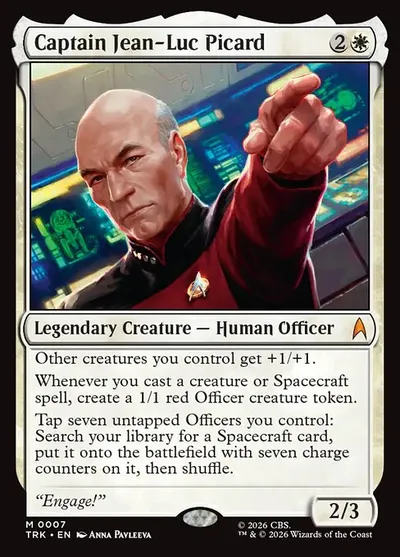
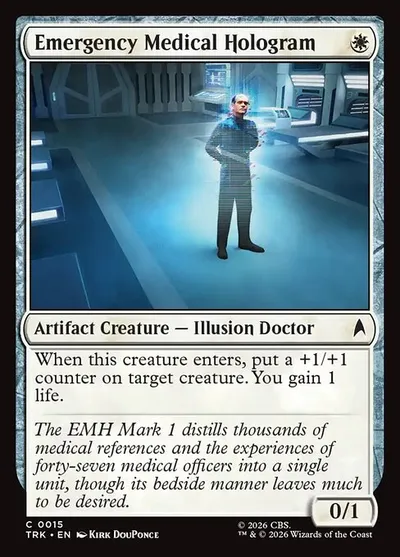
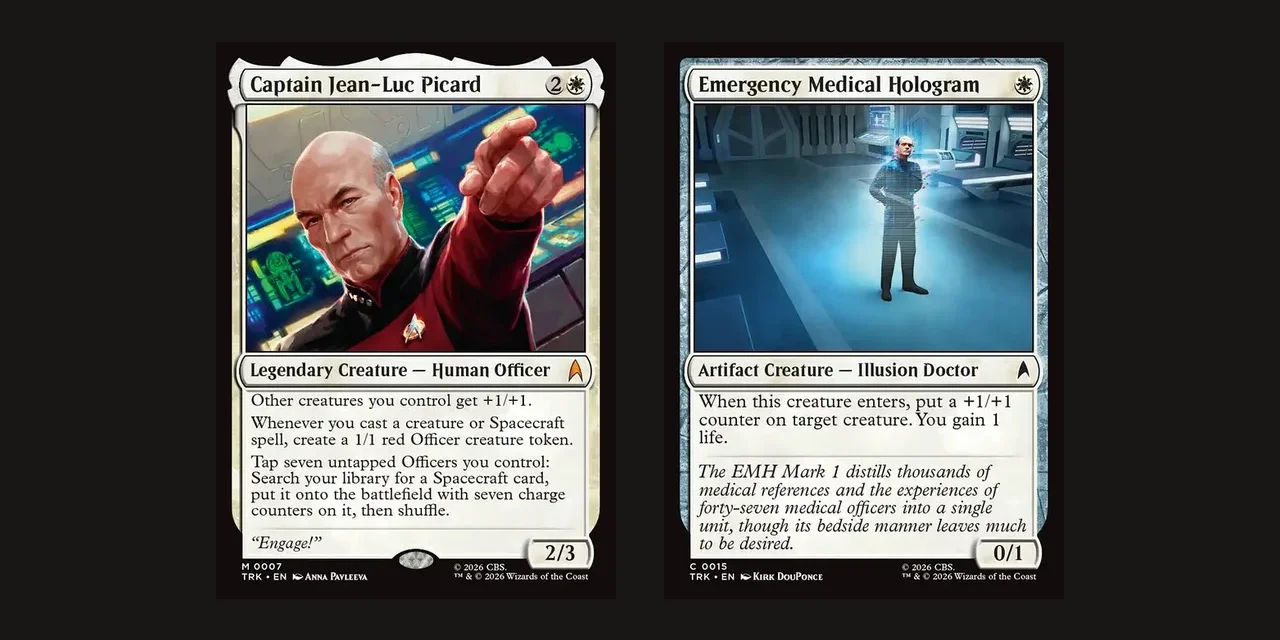
Both are official Wizards of the Coast scans from the MTG Star Trek set, which has 616 cards in the ColleX catalog.
Tests to skip: bend, rip and water
Harsher methods still circulate: bending a card nearly in half, the rip test to look at the inner layer, or wiping the edge with a damp tissue. Wizards described them back in 2004 as "at your own risk": bending and tearing damage even a real card, and none of them work on foils. Keep them away from any card you plan to keep or trade.
What Wizards does and does not do
Wizards has no card verification service; its support page on counterfeit cards, updated July 7, 2026, says so directly. It does not replace counterfeit cards, and cards mailed to it are not returned and get no reply. It does collect information about counterfeit producers, and under its 2016 policy it removes anyone who knowingly distributes counterfeits from the Wizards Play Network. The MTG counterfeit check itself stays with the buyer.
What is still unknown
As of 11/25/2026 the court has issued no ruling, the defendants have not responded publicly, and magic.wizards.com has published no separate statement on the suit. The $28.65 million figure is what the plaintiff asks for, not an award. This section will be updated when the case moves.
Tracking your MTG collection on ColleX
On ColleX, every Magic set lives under Magic: The Gathering with one entry per collector number, so a checklist shows exactly what is missing. Sets include Marvel Super Heroes, The Hobbit, Final Fantasy, Edge of Eternities, Avatar: The Last Airbender, Lorwyn Eclipsed and Secret Lair × Dune. Our beginner's guide explains how to read the rarity and collector line and what NM and LP mean. Next year's dates are in the MTG 2027 release schedule, the sets leaving Standard on January 29 are in the rotation breakdown, and Star Trek products and signed cards are covered in the set release story.
Frequently asked questions
How do you tell if an MTG card is fake?
Put a genuine card from the same set next to it and compare size, font, colors and the bottom-left line. Then look at the print under a loupe: a real card shows an even pattern of color dots and crisp black edges. On rares and mythics printed since 2014, check the holofoil stamp. No single test is conclusive, so combine several.
Are my Magic cards fake?
Start with your most expensive cards, since they deserve the closest look. Warning signs are washed-out or oversaturated colors, blurry text under a loupe, a stamp that looks like a sticker, and weight or stiffness that differs from a real card of the same set. If doubt remains, show the card to an experienced dealer or players at your local store.
What is the MTG light test?
You shine a phone flashlight through the card and compare it with a genuine one: a real non-foil card lets a little light through, while a fake often blocks it completely or glows differently. It is quick but unreliable, because many fakes pass. It does not work on foils.
What is the MTG green dot test?
The back of every card has a green dot. Under a loupe, a genuine card shows four red dots in an L shape inside its bright spot; collectors report that fakes often lack this pattern. It is one check among several, not final proof.
Does every Magic card have a holofoil stamp?
No. The shiny oval at the bottom center appears on rares and mythic rares starting with Magic 2015 (July 2014). Commons, uncommons, basic lands and rares printed before then have none.
What is the difference between a proxy and a counterfeit?
In the Wizards complaint, an honest proxy simply stands in for a card and makes no claim to authenticity, by appearance or otherwise. A counterfeit is made to be mistaken for the real card and to be owned, traded or sold as one.
Are MTG proxies legal in tournaments?
Not at sanctioned events: only authentic cards are allowed, and the only proxy is one a judge issues for a card damaged during that event. For personal, non-commercial play, Wizards said in its 2016 policy that it will not go after playtest cards such as a basic land with another card's name written on it. This article is not legal advice.
Who is Wizards of the Coast suing, and for what?
On November 23, 2026, Wizards filed suit in federal court in Seattle (case No. 2:26-cv-04617) against a Utah resident and related people and companies the complaint calls the "PrintMTG Enterprise". It alleges they sold counterfeit Magic cards as proxies and asks for an injunction, seizure of printing equipment and damages, including statutory damages of up to $28.65 million. As of 11/25/2026 the court has not ruled.
Does Wizards of the Coast verify cards?
No. Its support page says Wizards has no card verification service, does not replace counterfeits, and does not return or answer about cards mailed in. It only collects information about who makes counterfeits.
Can I swap spare MTG cards for ones I need, and trade them on ColleX?
You can, in any country where the ColleX Market is open. Mark spare copies Have along with how many you hold, and missing ones Want; ColleX then lines up people whose doubles fill your gaps while yours fill theirs, and you agree on the swap in chat. Run the checks above on any expensive card before it changes hands.
Sources: complaint, Wizards of the Coast LLC, No. 2:26-cv-04617 (U.S. District Court, W.D. Washington, November 23, 2026); Wizards of the Coast: "On Proxies, Policy, and Communication" (January 15, 2016), support article "Identifying Counterfeit Cards" (updated July 7, 2026), "Buyer Beware" (April 26, 2004), Wizards Play Network "Protect Yourself from Counterfeits" (July 28, 2014); card scans by Wizards of the Coast, STAR TREK ™ & © CBS Studios Inc.
This article is unofficial Fan Content permitted under the Fan Content Policy. Not approved/endorsed by Wizards. Portions of the materials used are property of Wizards of the Coast. ©Wizards of the Coast LLC.